
[OVERVIEW]
VaultPay is a fintech mobile application designed to simplify personal finance management through intuitive banking experiences, smart financial insights, and seamless money transfers.
The product combines account management, virtual cards, spending analytics, savings goals, and transaction tracking into a unified mobile experience. The objective was to create a modern digital banking platform that helps users understand, manage, and grow their finances through a secure and user-friendly interface.
Designed from scratch, the project focused on balancing usability, trust, and financial transparency while creating a scalable foundation for future banking services.


PROCESS
Type
Fintech Mobile Application
Process
Research
User Journey Mapping
Information Architecture
Wireframing
Design System
UI Design
Interactive Prototype
Usability Testing
Opportunity
Modern users interact with multiple financial products daily, yet many banking applications focus heavily on transactions while providing limited visibility into overall financial health.
This created an opportunity to design a more user-centered banking experience that not only supports everyday financial tasks but also helps users better understand their spending habits, savings progress, and financial behavior.
The goal was to transform banking from a transactional experience into a more insightful and engaging financial management platform.
Research & Discovery
The discovery phase focused on understanding user expectations, banking behaviors, and how people interact with modern financial products.
Research Activities
Fintech market analysis
Competitive product review
User journey mapping
Financial behavior research
Information architecture planning
Feature prioritization
Key Findings
Users primarily open banking apps to check balances and recent activity.
Spending insights are more valuable when presented visually.
Money transfers should require minimal effort and clear feedback.
Financial transparency increases trust and engagement.
Savings goals encourage long-term product adoption.
These findings helped define the product structure and establish priorities for the overall experience.
Key Product Decisions
Prioritizing Financial Visibility
Research indicated that users frequently check balances and recent transactions before performing any other action. To support this behavior, account visibility and transaction summaries were prioritized within the dashboard hierarchy.
Simplifying Money Transfers
Many banking applications introduce unnecessary complexity during transfers. The transfer experience was streamlined to reduce friction while maintaining clarity and user confidence throughout the process.
Making Analytics Actionable
Financial data can often feel overwhelming. Analytics were translated into visual charts and categorized insights, allowing users to understand spending behavior quickly without requiring financial expertise.
Encouraging Better Saving Habits
Savings goals were integrated directly into the experience to increase visibility and motivation. Progress indicators provide continuous feedback and encourage long-term financial engagement.
Building Trust Through Clarity
Trust is critical within financial products. Clear hierarchy, predictable interactions, and transparent information architecture were prioritized to create confidence throughout the experience.
UX Strategy & Solution
The design strategy focused on reducing complexity while providing users with greater visibility and control over their finances.
UX Strategy
Simplify everyday banking interactions
Improve financial visibility and awareness
Create intuitive money transfer experiences
Surface important information quickly
Build trust through clear visual hierarchy
Design scalable banking workflows
Solution
VaultPay was designed as a complete financial management ecosystem that combines banking functionality, analytics, savings, and card management within a single mobile experience.
The final solution provides users with quick access to financial information while reducing friction across core banking tasks, creating a seamless and intuitive banking experience.
User Flow
User flows were created to map key financial tasks and reduce unnecessary navigation across critical banking interactions.
Core Flows
Account Overview
Money Transfers
Virtual Card Management
Spending Analytics
Savings Goals
Profile Management
The flow structure focused on helping users complete tasks quickly while maintaining visibility into their financial activity.
Wireframes & UX Exploration
Low-fidelity wireframes were developed to validate navigation structures, information hierarchy, and financial workflows before moving into visual design.
Focus Areas
Dashboard hierarchy
Transaction visibility
Transfer experience
Analytics presentation
Savings journeys
Mobile navigation patterns
This phase helped identify usability improvements early and establish a strong foundation for the final interface.
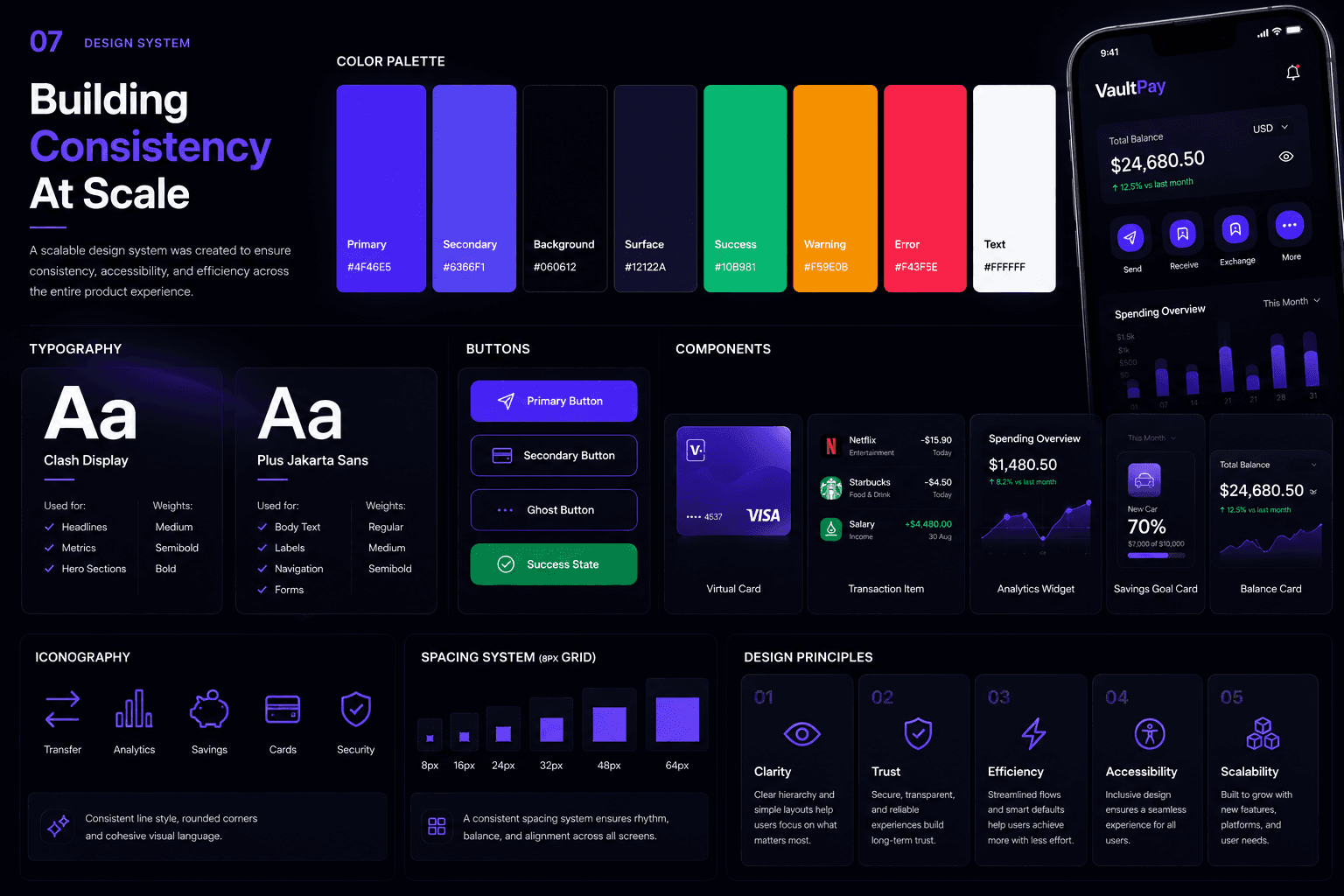
Design System
A scalable design system was developed to ensure consistency across all banking features and user interactions.
Design System Elements
Accessible color system
Typography hierarchy
Reusable UI components
Consistent spacing framework
Card and transaction patterns
Financial data visualization components
Interaction and feedback states
The system helped maintain consistency while supporting future scalability across the product ecosystem.
High-Fidelity UI Design
The visual design focused on creating a premium, trustworthy, and modern fintech experience.
UI Improvements
Simplified dashboard experience
Enhanced balance visibility
Improved transaction management
Intuitive card controls
Visual spending analytics
Goal-oriented savings experience
Consistent interaction patterns
The interface balances functionality with clarity, helping users manage finances confidently while maintaining a premium visual experience.
Prototype & Interaction
Interactive prototypes were developed to validate key workflows and refine interaction behavior before final delivery.
Included
Transfer flows
Card management interactions
Analytics exploration
Savings tracking
Success and confirmation states
Navigation transitions
Feedback interactions
This phase helped ensure a seamless and intuitive experience across all core banking features.
Outcomes
The final product successfully transformed complex financial management tasks into a streamlined mobile experience.
Design Outcomes
Improved visibility of financial information
Reduced interaction complexity across key workflows
Simplified money transfer experiences
Increased accessibility of financial insights
Established a scalable fintech design system
Unified multiple financial tools into a single platform
The result is a modern banking experience that helps users manage finances more confidently while providing a strong foundation for future product growth.
Reflections
This project reinforced the importance of balancing functionality with simplicity when designing financial products.
Key learnings included the value of prioritizing user goals, simplifying complex financial information, and creating trust through clarity and consistency.
The experience demonstrated that successful fintech products are not only defined by features, but by how effectively they help users understand and manage their financial lives.

